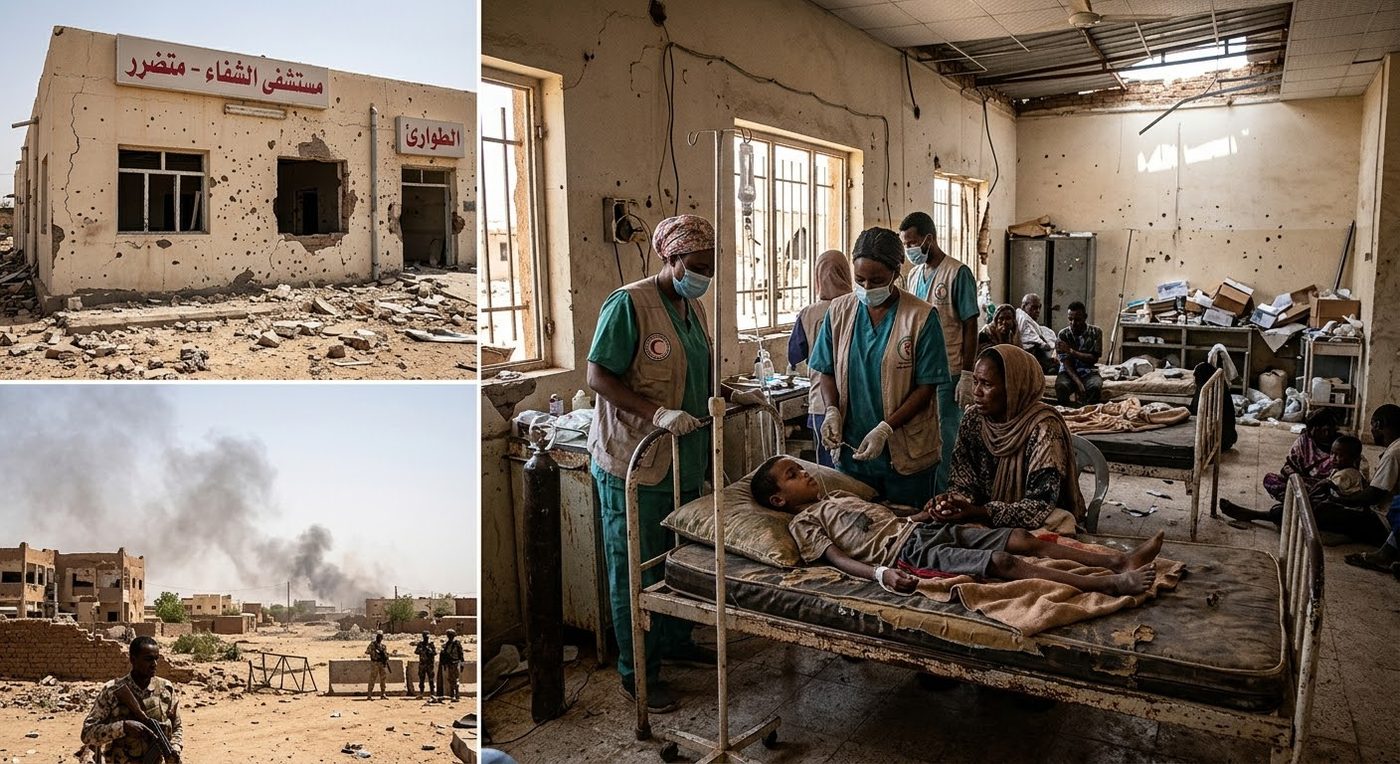
Armed conflict rarely kills the neurological patient with the first shell. It kills weeks later, when the carbamazepine runs out, the CT scanner has no power and the nearest ventilator is two states away. This review brings together what is known about people with epilepsy, stroke, headache, myasthenia gravis, Guillain–Barré syndrome and multiple sclerosis when war breaks a health system. It concentrates on Sudan since April 2023 and draws on Ukraine, Gaza, Syria and refugee settings. The Sudanese data are sobering. In one paediatric audit, 70% of children with epilepsy had gone at least 30 consecutive days without medication, and nearly one in five had developed status epilepticus. The wider evidence base is thin and mostly cross-sectional. It then covers mechanisms of harm, condition-specific risks, care without intravenous access, and practical measures from patient-held records to protected supply chains.
Introduction
Most writing on neurology and war is about wounds: blast injury, penetrating head trauma, damaged peripheral nerves. Far more people are hurt by the quiet failure of chronic care. Someone with well-controlled epilepsy becomes a person in status epilepticus. Someone with treatable myasthenia becomes a respiratory death. For these patients the war works through pharmacies, roads and power cuts.
Sudan is the clearest current example. Since fighting began in April 2023 the country has seen mass displacement and repeated, increasingly deadly attacks on health care1. A small body of Sudanese research has appeared since, much of it written by clinicians inside the crisis. This review reads it alongside other conflicts, aiming to be useful rather than comprehensive.
A caveat applies throughout. A 2017 Lancet review of 345 studies on public health interventions in humanitarian crises found only eight on non-communicable diseases2. Neurological disease is a small part of that small part. Much of what follows therefore rests on surveys, audits, expert consensus and general clinical knowledge, and the text says so where it does.
How conflict harms the neurological patient
Supply. In a survey of 118 community pharmacies across four Sudanese states between December 2024 and May 2025, 95.8% reported disrupted access to medicines and 98.3% reported price rises. Diazepam was available in only 15.3% and insulin in 11.0%3. In a community survey of 1,000 adults with chronic disease, 59.7% had difficulty obtaining their medicines. Common coping strategies were herbal remedies (22.2%) and reducing the dose (12.0%), and 23.6% had no alternative at all4. Neither study reported antiseizure medications individually, which is itself a gap.
Access and displacement. Insecurity, displacement and cost were the leading barriers in the same survey, and inaccessibility was associated with longer displacement and lower income4. In the Sudanese paediatric epilepsy studies, displacement was reported by more than half of caregivers and lack of transport by roughly a third5,6.
Records. People fleeing do not bring their files. In the Wad Medani audit, 43.8% of families had lost their child's medical records5. The American Academy of Neurology's review of forcibly displaced persons lists lost health records next to language barriers and fear of health systems as everyday clinical problems7. A neurologist who cannot see the previous EEG, the drug history or the antibody result is starting again from nothing.
Workforce and attacks on care. In Syria, hundreds of health workers were killed, imprisoned or tortured, hundreds of facilities were attacked, and experienced staff left the country in large numbers8. In Sudan, WHO had verified 201 attacks on health care between April 2023 and December 2025, with 1,858 deaths. In 2025 alone, deaths from attacks on health care in Sudan made up more than 80% of such deaths across all complex humanitarian emergencies worldwide1. Ukrainian neurologists describe the same pattern in a better-resourced system: shortages of staff and supplies, broken logistics and a lack of funding9.
Epilepsy
Epilepsy has the best Sudanese data and probably the most avoidable harm. A retrospective audit of 64 children at Wad Medani Paediatric Teaching Hospital (July–October 2025) found that only 21.9% were adherent. In all, 70.3% had gone 30 or more consecutive days without an antiseizure medication (ASM) in the preceding 90 days. Seizures became more frequent in 59.4%, 31.3% were admitted, and 18.8% had status epilepticus. Caregivers most often blamed stock-outs (62.5%), displacement (54.7%) and lost records (43.8%)5. A telephone study of 161 children from Khartoum and Gezira clinics, carried out in mid-2024, found 68.9% non-adherent. The most common reason was that the drug was not in the pharmacy (39.1%). Children who had relocated outside Sudan were more likely to be fully adherent6. Both studies are small and both rely on caregiver report.
In this war, most "non-adherence" in epilepsy means the drug was not there. The response is supply and continuity, not counselling.
The same vulnerability shows up in refugees who reach care. In a German emergency department during the 2015–16 influx, possible or confirmed seizures were three times as common among refugees as among native Germans (27% vs 9%). Refugees were also more often discharged with non-epileptic seizures or a psychiatric diagnosis10. Both need to be considered in displaced patients, usually without an EEG to separate them.
The most practical guidance comes from the ILAE task force formed after the invasion of Ukraine11,12. Its principles carry over well to Sudan:
Any available ASM is better than none. Switching carries risks of breakthrough seizures and adverse effects, and the patient should be told this, but stopping treatment carries greater ones. Some switches can be made directly. Carbamazepine to oxcarbazepine is the standard example, at a fixed conversion ratio (oxcarbazepine roughly one and a half times the carbamazepine dose in adults). Changing between licensed generics is usually acceptable. Extended-release products should not be swapped casually, and black-market supplies are a real hazard. When a drug that needs slow titration, such as lamotrigine, has to replace one that has run out, a benzodiazepine bridge with clobazam can cover the gap. It is then weaned once the new drug reaches a therapeutic dose. Bridging should be avoided in older people and anyone prone to delirium. In Dravet syndrome, sodium-channel blockers can make seizures worse and should be avoided even under pressure11.
Exact ratios, bridging doses and weaning schedules should be taken from the task force document, which is free in English, Ukrainian and Arabic, not from memory.
Stroke
Stroke care depends on more infrastructure than almost any other part of neurology: ambulance transport, CT, thrombolytics, a stroke unit, rehabilitation. War removes each of these. In an online survey of 431 Sudanese physicians in mid-2024, 48.7% said stroke outcomes had become significantly worse since the war began, and 58.0% believed incidence and severity had risen13. Respondents named supply shortages (71.5%), transport difficulties (64.5%) and damaged infrastructure (59.4%) as the main problems. Most rated diagnostic tools as poor or very poor (72.4%), and only 21.8% thought rehabilitation was adequate13. These are perceptions from a convenience sample, and physicians in Darfur and Kordofan could not be reached because of internet shutdowns. They are not measured outcomes, but they are the only systematic Sudanese data.
A 2025 review of stroke in conflict zones calls for rapid-response stroke units, tele-stroke and long-term registries of war-related stroke14. Where imaging is absent, the realistic aims are more basic, and they are standard stroke-unit practice rather than conflict-specific evidence. Swallow screening before oral intake, positioning and pressure-area care, prevention of aspiration, sensible blood-pressure management and secondary prevention all save lives. Aspirin should be given only when haemorrhage is thought unlikely, because without CT it remains a clinical judgement. Displaced experts ranked aspirin and clopidogrel among the most important neurological medicines to stock for refugees15.
Headache and migraine
Headache was the most common neurological complaint in every group in the German refugee emergency department study10. Beyond that, there is almost no conflict-specific evidence on migraine. General clinical knowledge supports some points. Sleep loss, missed meals, dehydration and stress all trigger migraine, and displacement supplies all four. When prophylactic drugs are unavailable, people use more analgesics, which risks medication-overuse headache. New or changed headache in a displaced person needs the usual red-flag assessment: fever, meningism, focal signs, papilloedema, onset after head injury. Cheap prophylaxis such as amitriptyline or propranolol is worth stocking.
Neuromuscular disease, including myasthenia gravis
No systematic data exist on myasthenia gravis in Sudan or any other recent conflict. What follows comes from the pharmacology literature and standard clinical knowledge.
The danger in war is that ordinary emergency medicine becomes a hazard for these patients. Aminoglycosides, fluoroquinolones and macrolides are all well documented to worsen myasthenia. A 2021 review advises avoiding each when a safer alternative exists. The same review urges caution with magnesium, especially intravenously, and notes that chloroquine has been associated with myasthenia emerging16. Gentamicin for sepsis, ciprofloxacin for diarrhoeal disease, azithromycin, magnesium sulphate for eclampsia and antimalarials are all routine in humanitarian practice. A patient with known or unrecognised myasthenia can therefore be pushed into crisis by standard treatment. Pyridostigmine interruption carries the same risk, and so does the start of high-dose corticosteroids, which can cause an early dip in strength (general clinical knowledge).
Myasthenic crisis needs airway support, and in many conflict settings no ventilator is available. Prevention therefore matters most: keep up pyridostigmine supplies, warn patients and carers about the drugs above, and refer early when bulbar or neck weakness progresses. Single-breath count and neck flexion strength are bedside measures that need no equipment. Guillain–Barré syndrome raises the same problems on a larger scale. Between June and October 2025, 123 cases and 17 deaths were reported in Gaza, and stocks of life-saving treatment ran out quickly17. Published commentary links the outbreak to malnutrition and contaminated water, with shortages of immunoglobulin, plasma-exchange filters and ventilators18.
Multiple sclerosis
Interrupting a disease-modifying therapy is not neutral in multiple sclerosis. After natalizumab is stopped, disease activity can return above pre-treatment levels. In one series of four patients, severe rebound began a mean of 3.5 months after natalizumab was stopped, with large increases in MRI lesions and seizures in one patient19. Stopping fingolimod can also cause severe rebound in a clinically important proportion of patients20. Natalizumab needs an infusion service and fingolimod needs regular monitoring; war removes both. Patients on these agents should be identified early, and any interruption planned rather than allowed to happen.
Stress itself may matter. In an Israeli cohort after October 2023, 38% of people with MS relapsed in the following year compared with 23% in the year before21. In another, new MRI activity during the first three months of the war was twice that of a comparison period22. Neither study shows causation. It is also basic clinical knowledge that fever and heat can unmask old deficits in MS (pseudo-relapse, Uhthoff phenomenon). In a camp with endemic infection, a patient whose weakness worsens should first be checked for fever and infection before being given steroids, which may be scarce and are not harmless.
When there are no IV fluids or IV drugs
Much of acute neurology assumes a cannula. Often there is none.
For prolonged seizures, non-intravenous benzodiazepines work. In a paediatric randomised trial, buccal midazolam stopped seizures within ten minutes, without respiratory depression needing intervention, in 56% of episodes compared with 27% for rectal diazepam23. Intranasal midazolam is an accepted alternative where available (general clinical knowledge). When neither benzodiazepines nor IV equipment exist, the ILAE task force notes that some maintenance ASMs can be given rectally. It specifically advises against the rectal route for oxcarbazepine, eslicarbazepine, phenytoin, lorazepam and midazolam, which are poorly absorbed that way11. Hypoglycaemia should be excluded or treated in any seizing patient. The mhGAP Humanitarian Intervention Guide includes this in its epilepsy module for non-specialists24.
For hydration, oral rehydration solution, given by mouth or nasogastric tube, covers most needs in a patient who is conscious and swallowing safely. The real risk is aspiration in stroke, bulbar myasthenia or reduced consciousness, where a swallow assessment has to come first. (These points are general clinical knowledge.)
What clinicians and systems can do
Patient-held records. A one-page summary on paper or a phone photograph should list diagnosis, current drugs and doses, allergies, key investigations and a contact. It costs almost nothing and addresses one of the commonest barriers in the Sudanese data5,7. The ILAE also publishes multilingual phrase sheets for taking an epilepsy history11.
Essential medicines. An international Delphi panel on neurological care for displaced people ranked antiseizure medications at the top of its priorities, with levetiracetam, carbamazepine and valproate in the top ten. It also recommended that funders reserve part of relief budgets for neurological treatment and buy through regional suppliers15.
Task-sharing. The mhGAP Humanitarian Intervention Guide gives non-specialist health workers first-line management of epilepsy and other conditions24. Its valproate addendum for women and girls of reproductive age should be followed. Training more front-line staff in basic neurological diagnosis is one of the Delphi panel's central recommendations15.
Telemedicine. Teleneurology linking front-line staff to neurologists has been used by humanitarian organisations15, and tele-stroke is a stated priority in the stroke literature14. It works only where there is connectivity, and internet shutdowns in parts of Sudan show how fragile that is13.
Protecting supply chains and care. None of the above helps if pharmacies are looted and hospitals are targeted. Recording and reporting attacks on health care, as WHO does, is part of neurological care in war1,8.
Conclusion
The neurological toll of war comes mainly from the slow loss of continuity, not from dramatic injury. Antiseizure drugs disappear, children go untreated for weeks, status epilepticus follows, stroke care loses imaging and rehabilitation, and records are lost with every move. Better evidence is needed, especially on adults, myasthenia, MS and outcomes rather than perceptions. The practical response does not have to wait for it. Any ASM beats none. Non-intravenous rescue routes work. Dangerous drugs in myasthenia are known. High-efficacy MS therapies should not be stopped without a plan. And a single sheet of paper in the patient's pocket can stand in for a lost hospital file.
References
- World Health Organization Regional Office for the Eastern Mediterranean. WHO warns of dangerous escalation of attacks on health care in Sudan [news release]. 19 December 2025. emro.who.int
- Blanchet K, Ramesh A, Frison S, Warren E, Hossain M, Smith J, et al. Evidence on public health interventions in humanitarian crises. Lancet. 2017;390(10109):2287–96. doi:10.1016/S0140-6736(16)30768-1
- Ahmed N, Zamel AMA, Ahmed SG, et al. A multi-state cross-sectional assessment of essential medicine availability in Sudan during armed conflict. Sci Rep. 2026;16:12301. doi:10.1038/s41598-026-41811-w
- Sidahmed TSM, El-Haj ARMOK, Abdelgadir HS, Ahmed AK, Mohammed AES, Hassan AAEZ, et al. Chronic disease medications accessibility among Sudanese patients during war. Discov Health Syst. 2025;4:73. doi:10.1007/s44250-025-00249-z
- Saad HEHB, Eltahir SHM. Medication adherence and treatment gap in Sudanese children with epilepsy during armed conflict: a one-unit retrospective clinical audit. BMC Pediatr. 2026;26:822. doi:10.1186/s12887-026-07196-5
- Abdelhafiz AAA, Abdelhafiz AAA, Mohamed KO, Abdelraheem E, Omer LM, Altayib LS. Adherence to anti-seizure medications among pediatric epilepsy patients during the Sudan armed conflict. Confl Health. 2026;20(1):48. doi:10.1186/s13031-026-00783-4
- Mateen FJ, Hanafi I, Birbeck GL, Saadi A, Schmutzhard E, Wilmshurst JM, et al.; AAN Quality Committee. Neurologic care of forcibly displaced persons: emerging issues in neurology. Neurology. 2023;100(20):962–9. doi:10.1212/WNL.0000000000206857
- Fouad FM, Sparrow A, Tarakji A, Alameddine M, El-Jardali F, Coutts AP, et al. Health workers and the weaponisation of health care in Syria: a preliminary inquiry for The Lancet–American University of Beirut Commission on Syria. Lancet. 2017;390(10111):2516–26. doi:10.1016/S0140-6736(17)30741-9
- Flomin Y, Dubenko A, Dubenko O, Sokolova L, Slobodin T, Shepotinnyk Y, et al. Neurological practice in the time of war: perspectives and experiences from Ukraine. Semin Neurol. 2024;44(2):225–32. doi:10.1055/s-0044-1782515
- Brinckmann MP, van Noort BM, Leithner C, Ploner CJ. Neurological emergencies in refugees. Front Neurol. 2018;9:1088. doi:10.3389/fneur.2018.01088
- ILAE Emergency Response (Ukraine) Task Force. Treatment strategies in people with epilepsy during times of shortage of antiseizure medications. International League Against Epilepsy; 2022. Available via ILAE Crisis Response resources. ilae.org
- Asadi-Pooya AA, Patel AA, Trinka E, Mazurkiewicz-Beldzinska M, Cross JH, Welty TE. Recommendations for treatment strategies in people with epilepsy during times of shortage of antiseizure medications. Epileptic Disord. 2022;24(5). doi:10.1684/epd.2022.1468
- Mohammed FEA, Ahmed MJ, MohamedAhmed BBA, Mohamed A, Ahmed NME, Gandour HMN, et al. Sudanese physicians' insights on managing stroke during Sudan's war 2024. BMC Neurol. 2026;26:2. doi:10.1186/s12883-025-04539-0
- Ozturk S, Sunguc C. Stroke care in conflict and war zones – peace saves lives! Curr Neurol Neurosci Rep. 2025;25(1):62. doi:10.1007/s11910-025-01454-2
- Rezaei S, Sakadi F, Hiew FL, Rodriguez-Leyva I, Kruja J, Wasay M, et al. Practical needs and considerations for refugees and other forcibly displaced persons with neurological disorders: recommendations using a modified Delphi approach. Gates Open Res. 2022;5:178. doi:10.12688/gatesopenres.13447.2
- Sheikh S, Alvi U, Soliven B, Rezania K. Drugs that induce or cause deterioration of myasthenia gravis: an update. J Clin Med. 2021;10(7):1537. doi:10.3390/jcm10071537
- Health Cluster, occupied Palestinian territory (WHO-led Rehabilitation Task Force). Powerless in Gaza: Guillain-Barré syndrome brief. 20 October 2025. healthcluster.who.int
- Haider E, Patel T, Hanani CM. Malnutrition, contaminated water, and post-infectious neuropathies: lessons from the Guillain-Barré syndrome outbreak in Gaza. Ann Med Surg (Lond). 2026;88(1):1044–5. PubMed 41496933
- González-Suarez I, Rodríguez de Antonio L, Orviz A, Moreno-García S, Valle-Arcos MD, Matias-Guiu JA, et al. Catastrophic outcome of patients with a rebound after natalizumab treatment discontinuation. Brain Behav. 2017;7(4):e00671. doi:10.1002/brb3.671
- Członkowska A, Smoliński Ł, Litwin T. Severe disease exacerbations in patients with multiple sclerosis after discontinuing fingolimod. Neurol Neurochir Pol. 2017;51(2):156–62. doi:10.1016/j.pjnns.2017.01.006
- Aloni R, Dror C, Barazani T, Kalron A. Wartime stress and relapse risk in people with multiple sclerosis: a prospective cohort study. J Neurol. 2025;272(9):619. doi:10.1007/s00415-025-13366-9
- Zveik O, Friedman-Korn T, Rechtman A, Ganz T, Hoichman G, Shweiki L, et al. Subclinical imaging activity in multiple sclerosis patients during war-related psychological stress. Ann Clin Transl Neurol. 2025;12(1):17–25. doi:10.1002/acn3.52241
- McIntyre J, Robertson S, Norris E, Appleton R, Whitehouse WP, Phillips B, et al. Safety and efficacy of buccal midazolam versus rectal diazepam for emergency treatment of seizures in children: a randomised controlled trial. Lancet. 2005;366(9481):205–10. doi:10.1016/S0140-6736(05)66909-7
- World Health Organization, United Nations High Commissioner for Refugees. mhGAP Humanitarian Intervention Guide (mhGAP-HIG): clinical management of mental, neurological and substance use conditions in humanitarian emergencies. Geneva: WHO; 2015. who.int